WHAT IT TAKES : An income reality check for working artists
Every pricing guide tells you what to charge. None of them tell you how many paintings that means.
You've read the formulas. Square inches times a dollar rate. Cost of materials times three. Whatever the artist down the road is getting.
And then you set a price, and the year goes by, and the money doesn't arrive, and you have no idea whether the problem was the number or something else entirely.
What It Takes answers the question the formulas skip.
Put in what you need to earn for the year. Put in what you actually charge, what you actually sold last year, and how many pieces you can realistically finish. It shows you the year from both directions:
How many sales your current price requires. Not a vague "sell more" but an actual number, and what that works out to per month.
The price you'd need at the sales you've already proven you can make. This is the number almost no artist has ever seen, and it changes how people think about their own work.
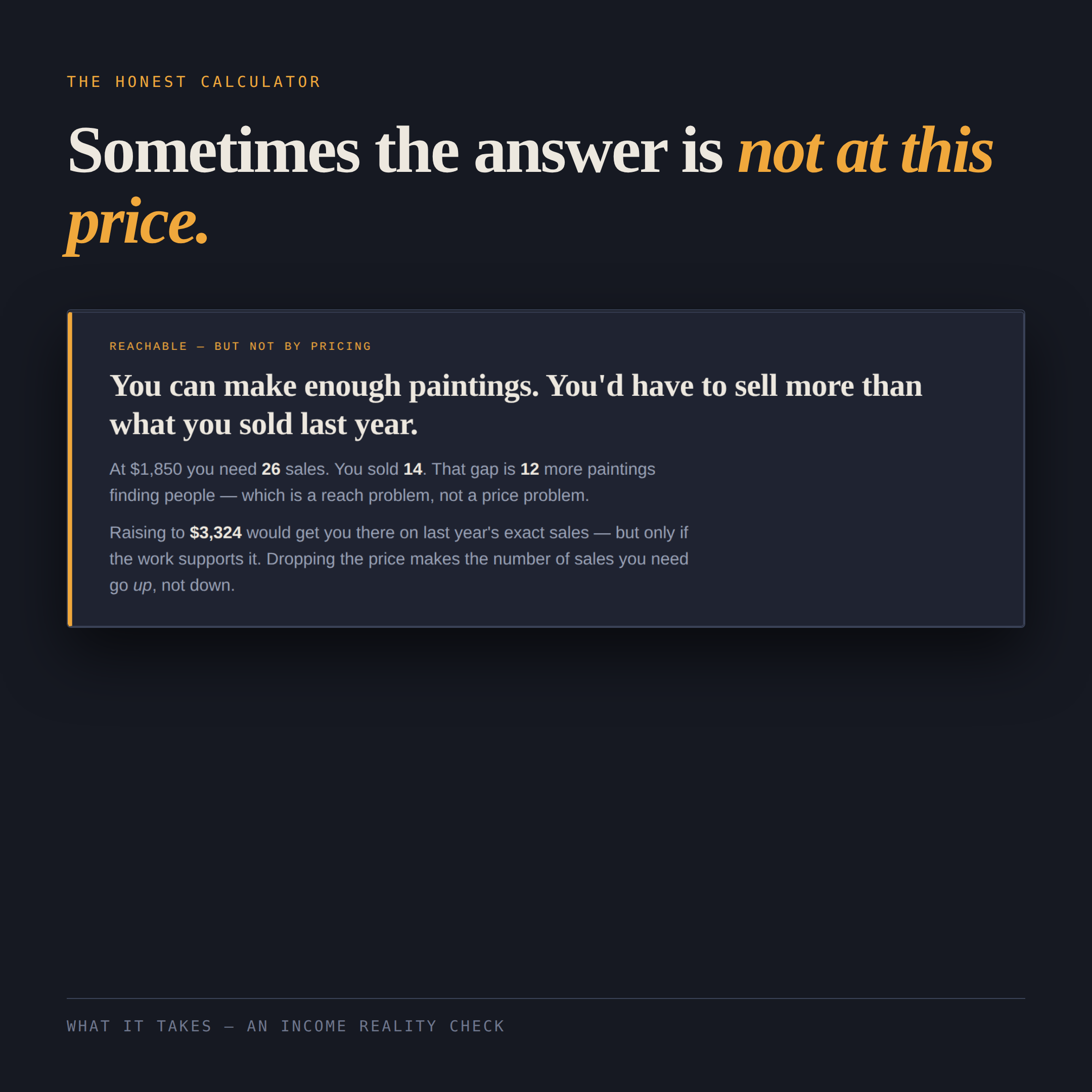
Whether the year is even long enough. If reaching your target would take more paintings than you can physically make, it says so plainly; and shows you what the price would have to be instead.
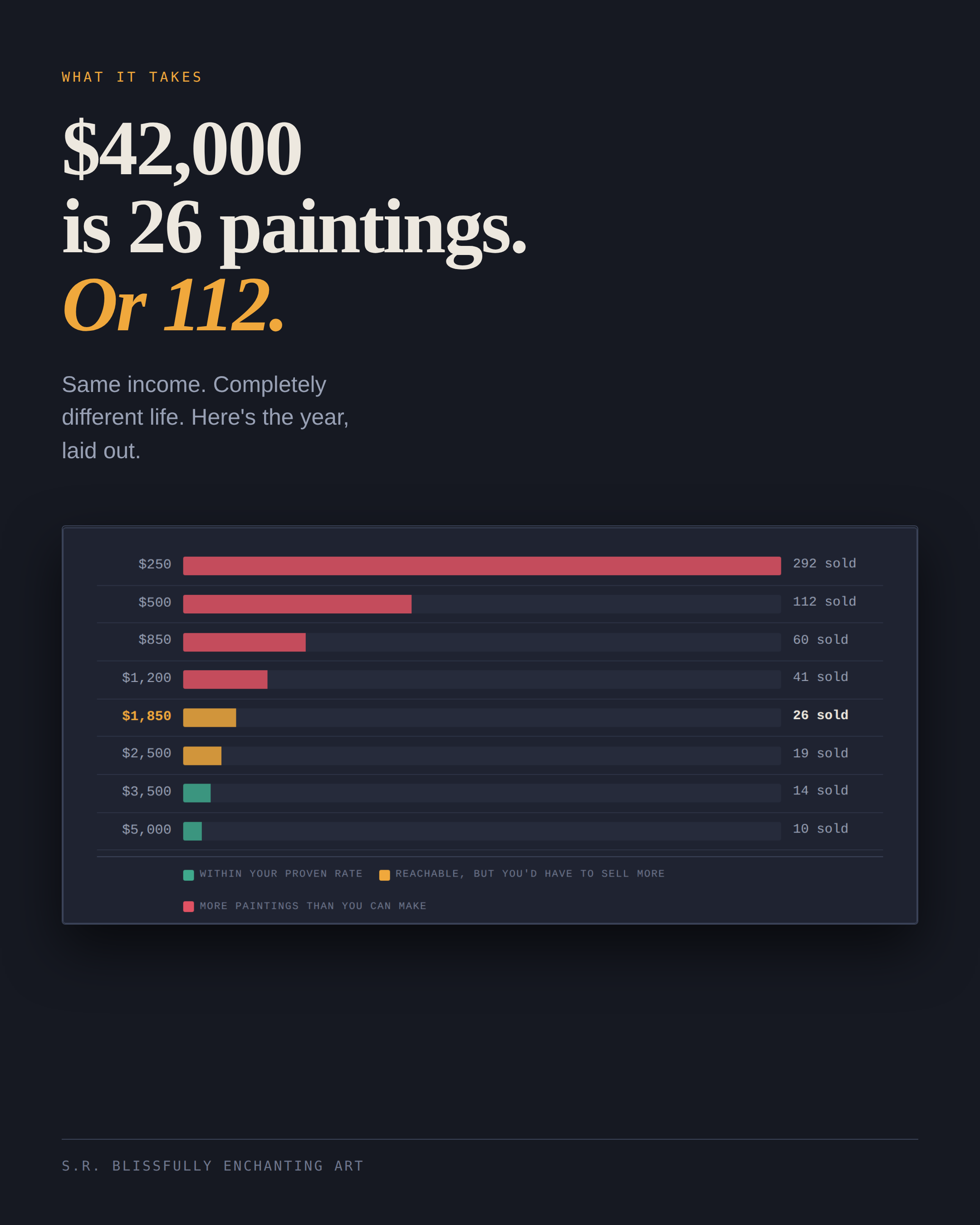
The full trade, laid out. Eight price points side by side, each one showing the sales it demands, color-coded against what you've proven and what you're capable of. You can watch a $30,000 year go from 120 paintings to 12 as the price climbs.
It will tell you things you might not want to hear.
Most tools are built to make you feel good about your pricing. This one is built to be right.
If your price doesn't clear your materials and commission, it stops you before you go further. If no price gets you to your target at your current pace, it says that out loud instead of handing you a number that flatters you.
That's not discouragement. It's the difference between "I don't know why this isn't working" and "I know exactly what would have to change." One of those you can act on.
And it will show you the thing nobody says out loud.
Lowering your price feels like the fix. It almost never is.
Drag the price down in this tool and watch the bar get longer — because a cheaper painting means you need more of them, and there were never enough hours in the year to begin with. A painting stalling at $1,200 is rarely failing at $1,200. It's failing at forty people knowing it exists.
Seeing that on a screen lands differently than reading it in a blog post.
What you get
A single file that opens in any browser — Mac, PC, phone, tablet
No account, no subscription, no login, nothing to install
Nothing is uploaded, tracked, or stored. Your numbers stay on your machine
Yours to keep and use for as long as you're making work
Who it's for
Painters, printmakers, sculptors, and mixed media artists who are trying to make real money from real work — whether that's a full living or a serious second income. Especially useful if you're unrepresented, pricing on instinct, or you've been at it a while and can't tell whether the plateau is your prices or your reach.
Who it isn't for
If you're looking for a tool that tells you your work is worth more than you thought, this isn't it. Sometimes it says that. Sometimes it doesn't.
A note from me
I've been painting for about forty years. I have the degrees. I've done the shows, the commissions, the classes, the galleries.
And for most of those years I priced by feel, hoped it worked out, and never once sat down and asked how many paintings a year I'd actually need to sell to live on. Nobody hands you that math. Art school doesn't teach it. The pricing articles skip it, because the honest answer isn't always encouraging.
I built the tool I wish someone had put in front of me at twenty-two. Not a calculator that flatters you: one that tells you the truth and leaves the decision where it belongs, which is with you.
Shannon Rios S.R. Blissfully Enchanting Art
Every pricing guide tells you what to charge. None of them tell you how many paintings that means.
You've read the formulas. Square inches times a dollar rate. Cost of materials times three. Whatever the artist down the road is getting.
And then you set a price, and the year goes by, and the money doesn't arrive, and you have no idea whether the problem was the number or something else entirely.
What It Takes answers the question the formulas skip.
Put in what you need to earn for the year. Put in what you actually charge, what you actually sold last year, and how many pieces you can realistically finish. It shows you the year from both directions:
How many sales your current price requires. Not a vague "sell more" but an actual number, and what that works out to per month.
The price you'd need at the sales you've already proven you can make. This is the number almost no artist has ever seen, and it changes how people think about their own work.
Whether the year is even long enough. If reaching your target would take more paintings than you can physically make, it says so plainly; and shows you what the price would have to be instead.
The full trade, laid out. Eight price points side by side, each one showing the sales it demands, color-coded against what you've proven and what you're capable of. You can watch a $30,000 year go from 120 paintings to 12 as the price climbs.
It will tell you things you might not want to hear.
Most tools are built to make you feel good about your pricing. This one is built to be right.
If your price doesn't clear your materials and commission, it stops you before you go further. If no price gets you to your target at your current pace, it says that out loud instead of handing you a number that flatters you.
That's not discouragement. It's the difference between "I don't know why this isn't working" and "I know exactly what would have to change." One of those you can act on.
And it will show you the thing nobody says out loud.
Lowering your price feels like the fix. It almost never is.
Drag the price down in this tool and watch the bar get longer — because a cheaper painting means you need more of them, and there were never enough hours in the year to begin with. A painting stalling at $1,200 is rarely failing at $1,200. It's failing at forty people knowing it exists.
Seeing that on a screen lands differently than reading it in a blog post.
What you get
A single file that opens in any browser — Mac, PC, phone, tablet
No account, no subscription, no login, nothing to install
Nothing is uploaded, tracked, or stored. Your numbers stay on your machine
Yours to keep and use for as long as you're making work
Who it's for
Painters, printmakers, sculptors, and mixed media artists who are trying to make real money from real work — whether that's a full living or a serious second income. Especially useful if you're unrepresented, pricing on instinct, or you've been at it a while and can't tell whether the plateau is your prices or your reach.
Who it isn't for
If you're looking for a tool that tells you your work is worth more than you thought, this isn't it. Sometimes it says that. Sometimes it doesn't.
A note from me
I've been painting for about forty years. I have the degrees. I've done the shows, the commissions, the classes, the galleries.
And for most of those years I priced by feel, hoped it worked out, and never once sat down and asked how many paintings a year I'd actually need to sell to live on. Nobody hands you that math. Art school doesn't teach it. The pricing articles skip it, because the honest answer isn't always encouraging.
I built the tool I wish someone had put in front of me at twenty-two. Not a calculator that flatters you: one that tells you the truth and leaves the decision where it belongs, which is with you.
Shannon Rios S.R. Blissfully Enchanting Art